
Bulging disc pain? Start with a clear plan.
Back or neck pain, sciatica, pins and needles, or a scan showing a disc bulge can leave you wondering what to do next. At DC Physiotherapy, your plan can bring together non-surgical spinal decompression, laser, Chartered Physiotherapy and specific rehabilitation, guided by your symptoms and assessment.
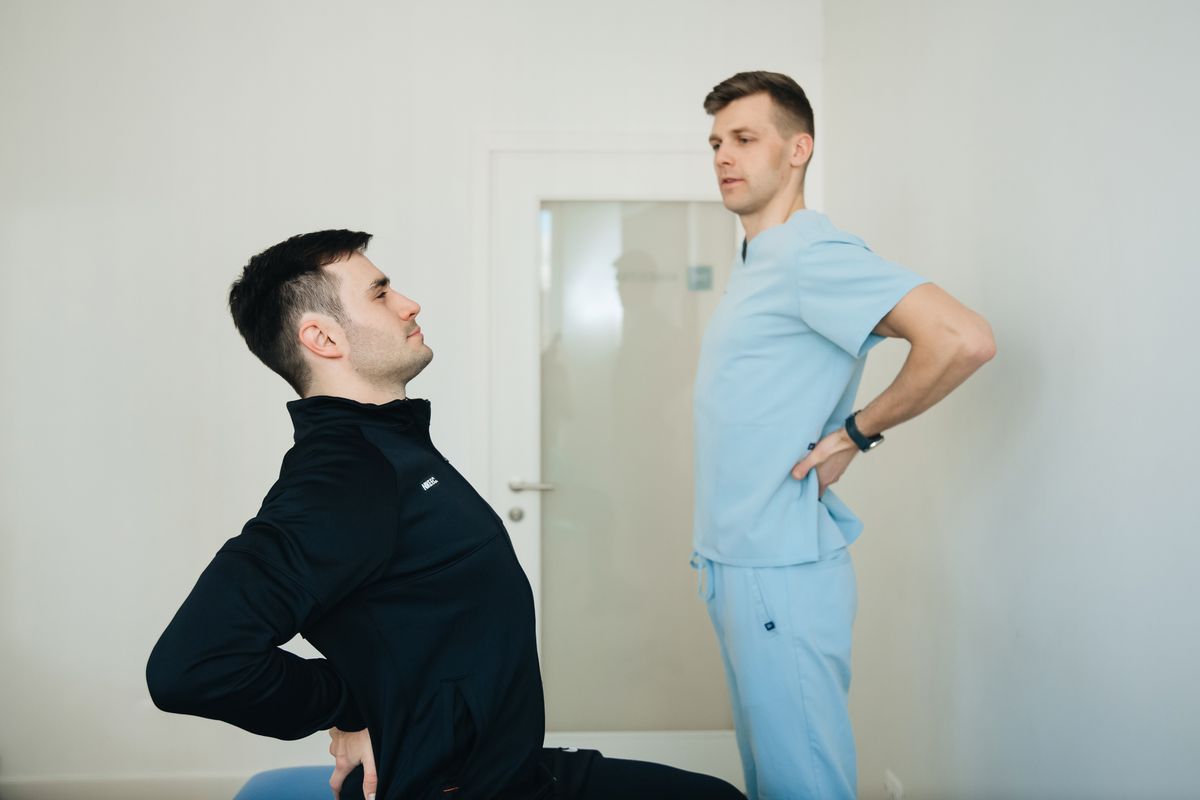
What does a bulging disc mean?
A spinal disc sits between the bones of your spine and helps distribute load as you move. A bulging disc describes disc tissue extending beyond its usual boundary. People may also see terms such as disc protrusion, slipped disc, ruptured disc or disc prolapse. These words describe related disc changes, but they do not by themselves tell us exactly what you feel or which treatment will suit you.
Some people have a bulge on an MRI without pain. Others experience back or neck pain, buttock or leg pain, shoulder or arm symptoms, tingling or changes in strength. The level named on a report, such as L4-L5, L5-S1 or C6-C7, helps guide the assessment, while your history, movement, strength and symptom behaviour help shape the plan.
 A disc change, explained simply
Four parts of a plan, working towards the same goal.
We aim to help settle symptoms, improve movement and build confidence for everyday life. Your Chartered Physiotherapist will explain which elements fit your assessment and how progress will be reviewed.
Non-surgical spinal decompression
Computer-guided traction applies controlled, targeted unloading to the selected spinal region. For appropriate lumbar radiculopathy presentations, a randomized trial found that adding non-surgical decompression to routine physiotherapy improved pain, disability, movement and back-muscle endurance more than routine physiotherapy alone over four weeks.
Therapeutic laser
Laser is used as an adjunct to help address pain and support comfortable movement. A randomized trial in disc-related lumbar radiculopathy reported better pain, disability and movement outcomes when low-level laser was added to conventional physiotherapy. It is part of a wider plan rather than a replacement for active rehabilitation.
Chartered Physiotherapy
Your physiotherapist reviews symptom history, daily activities, movement, strength and relevant neurological signs. You receive an explanation of the findings, practical advice and a programme that responds to your goals, whether those involve walking, work, sleep, sport or caring responsibilities.
Specific back rehabilitation
Rehabilitation can include graded trunk and hip strengthening, mobility, walking tolerance, lifting practice and a gradual return to meaningful activities. Exercises are selected and progressed to match your presentation, rather than relying on a generic list.
Progress checks and adjustments
Your response helps guide the next step. We can review pain, leg or arm symptoms, mobility, strength and the activities that matter to you, then adjust the treatment and exercise plan as capacity builds.
Clear recommendations
Leave with a better understanding of what may be contributing to your symptoms and what you can work on next. If your assessment suggests another pathway would be more useful, your physiotherapist will discuss that with you.
Ready to understand your options?
Book an assessment and start with a plan built around your back, your symptoms and your goals.
Common disc questions, answered in plain English.
Use this guide to understand common terms and treatment options. The information is educational and cannot diagnose your individual symptoms.
Bulging disc treatment and bulging disc relief
Bulging disc treatment often starts with understanding which movements and positions affect your symptoms, then building a practical plan. Depending on your assessment, this may include non-surgical spinal decompression, laser, Chartered Physiotherapy, activity guidance and specific back rehabilitation. The aim is to improve day-to-day function and help you move with more confidence.
For bulging disc pain relief, your physiotherapist may help you find tolerable ways to sit, stand, walk and change position, while gradually restoring the activities you have reduced. Progress is guided by how your back and leg symptoms respond.
Physical therapy for a herniated disc
Physical therapy for a herniated disc can combine education, movement practice, mobility work, progressive strengthening and activity-specific training. For some people, a structured plan may also include spinal decompression and laser as adjuncts. The focus is to build function and confidence while responding to symptoms such as back pain, sciatica or restricted movement.
Exercises are adapted to the person. A physiotherapist can show you how to begin at a suitable level and progress without guessing from an online routine.
Disc protrusion, prolapse, slipped or ruptured disc treatment
Disc protrusion treatment, disc prolapse treatment, slipped disk treatment and ruptured disc treatment are common search phrases for back or neck symptoms related to disc changes. The exact term on an MRI report is only one piece of information. Treatment planning also considers symptom distribution, strength, sensation, movement and the impact on daily life.
A conservative plan may include physiotherapy, rehabilitation and, where appropriate, non-surgical spinal decompression and laser. Your clinician explains how the proposed plan relates to your assessment.
Treatment for a bulging disc in the lower back
Treatment for a bulging disc in the back or lower back may be considered when pain is local to the back or travels into the buttock or leg. Lumbar disc symptoms can include stiffness, difficulty bending, discomfort with prolonged sitting or standing, and nerve-related symptoms such as tingling. Your assessment helps identify the movements and positions you can build on.
Care can combine decompression, laser, physiotherapy and graded back rehabilitation when these suit the presentation. Walking, trunk control and hip strength are common components of a progressive programme.
Treatment for a bulging disc in the neck
A bulging disc in the neck may be associated with neck pain, stiffness or symptoms travelling into the shoulder, arm or hand. Treatment for a cervical disc bulge is based on an assessment of neck and upper-limb movement, strength and sensation, along with the activities that trigger or ease symptoms.
Physiotherapy may include comfortable neck movement, postural variation, shoulder and upper-back conditioning, and practical pacing. Decompression or laser may be discussed when appropriate to the findings and treatment goals.
Bulging disc surgery: when is it discussed?
Many people first explore non-surgical options for a bulging or herniated disc. A clinician can help you understand conservative care, monitor changes in strength and function, and discuss when a GP or spine specialist opinion may be useful. Surgery decisions are made with the relevant medical team using symptoms, examination findings, imaging and personal circumstances.
Starting with a physiotherapy assessment can give you a clearer picture of your current function and a structured approach to rehabilitation.
Acupuncture for bulging discs
People often search for acupuncture for bulging discs when looking for symptom relief. Acupuncture may be considered as one part of some pain-management plans, but it does not replace an assessment or a progressive rehabilitation approach. At DC Physiotherapy, the core plan described here focuses on spinal decompression where suitable, laser, Chartered Physiotherapy and specific back rehabilitation.
Your physiotherapist can talk through the options and how they relate to the goals you want to reach.
What can you do while waiting for an assessment?
Keep gently active within your current tolerance, change position regularly and choose movements that feel manageable. Note which activities bring on back, leg, neck or arm symptoms and how long they take to settle. This information can help your physiotherapist understand your pattern and tailor your first plan.
If you notice a sudden change in bladder or bowel control, numbness around the saddle area, or rapidly worsening leg or arm weakness, seek urgent medical care.
L4-L5, L5-S1, L3-L4-L5 and C6-C7 disc bulge treatment
Level names describe where a disc sits. They help orient your assessment but do not determine a treatment plan on their own.
| Search term / level | What people may be looking for | How treatment planning is approached |
|---|---|---|
| L4-L5 disc bulge treatment | Lower-back pain, buttock or leg symptoms, or a scan describing an L4-L5 bulge. | Assessment of lumbar movement, leg symptoms, strength and daily function. A plan may combine decompression, laser, physiotherapy and graded rehabilitation when suitable. |
| L5-S1 disc bulge treatment | Back pain with symptoms that may travel into the buttock, calf or foot. | Review of symptom behaviour, walking and strength, followed by treatment matched to the findings and progress over time. |
| L3-L4-L5 disc bulge treatment | More than one level described on an MRI report, often alongside back or leg pain. | Connect imaging with the overall clinical picture and focus on movement, function and rehabilitation goals rather than the scan wording alone. |
| C6-C7 disc bulge treatment | Neck or shoulder pain, or symptoms that may travel into the arm or hand. | Assessment of neck and arm movement, sensation and strength, with a tailored cervical and upper-limb plan. |
Exercises may help you build capacity, one step at a time.
These are examples, not a personal prescription. Your physiotherapist can choose the right starting point, technique and progression for your symptoms.
Comfortable walking
Short, manageable walks can build general activity and walking tolerance. Start at a distance that feels achievable and progress gradually as your response allows.
Trunk bracing and breathing
Practise gentle abdominal engagement while breathing normally, first in a comfortable lying or seated position. This introduces trunk control before more demanding strengthening.
Bridge progression
A small-range bridge trains the hips and trunk together. Your therapist can adjust the range, repetitions or position to suit your back and leg symptoms.
Bird-dog variations
Begin with a controlled arm or leg movement in a comfortable tabletop position. Progress towards opposite arm and leg reach when you can maintain steady, comfortable control.
Hip mobility and strength
Gentle hip mobility and gradual strength work can support lifting, stairs and walking. Sit-to-stand is one possible starting point; the exercise depends on your assessment and goals.
Graded lifting practice
Practise a light, comfortable hinge or sit-to-stand, then build load and range in stages. The goal is to regain confidence for real tasks with a progression that suits you.
What randomized trials have reported
Here are a few examples relevant to lumbar disc-related symptoms. Studies use specific equipment, doses and patient groups; they inform treatment choices but cannot predict any one person’s result.
Added decompression showed better short-term outcomes than physiotherapy alone
A 2022 randomized trial assigned 60 people with lumbar radiculopathy to routine physiotherapy with or without non-surgical spinal decompression. After 12 sessions over four weeks, the decompression group had greater improvements in pain, disability, movement, back-muscle endurance and selected quality-of-life measures.
Read the PubMed abstract →Laser was studied as an adjunct for disc-related lumbar radiculopathy
A double-blind randomized trial of 110 people compared conventional physiotherapy with the same physiotherapy plus low-level laser. The authors reported statistically significant between-group differences in pain, disability and lumbar movement after 18 sessions.
Read the PubMed abstract →A disc-protrusion trial examined laser added to spinal decompression
In a randomized study of 63 people with lumbar disc protrusion, both groups received a spinal decompression system, while one group also received high-intensity laser. The laser group had better short-term changes in disability, lumbar flexion and straight-leg-raise angle; between-group pain differences were not statistically significant.
Read the PubMed abstract →These are separate studies of particular protocols. They support considering decompression and laser as adjuncts to physiotherapy for selected presentations; they do not test DC Physiotherapy’s exact treatment programme or establish the same result for every disc level or individual.
Bulging disc treatment FAQs
Can a bulging disc get better without surgery?
Many people explore non-surgical care such as physiotherapy, activity guidance and progressive rehabilitation. Some may also be suitable for spinal decompression or laser as part of a wider plan. The right pathway depends on symptoms, examination findings, health history and your goals.
Is spinal decompression the same as ordinary physiotherapy?
Non-surgical spinal decompression is a specific form of computer-guided traction. It can be combined with Chartered Physiotherapy, laser and exercise-based rehabilitation when appropriate. A randomized trial in lumbar radiculopathy found better short-term outcomes when decompression was added to routine physiotherapy, though results depend on the protocol and patient group studied.
Can laser help a herniated or bulging disc?
Some randomized trials have studied laser as an adjunct for lumbar disc-related radiculopathy and reported improvements in pain, disability or movement outcomes. Laser is used alongside assessment and rehabilitation, with the plan tailored to the presentation.
Does an MRI showing a disc bulge mean I need surgery?
An MRI finding alone does not decide whether surgery is needed. Medical decisions consider symptoms, examination, neurological changes, imaging and personal circumstances. A physiotherapist can assess your function and discuss whether GP or specialist input should be part of your next step.
What does L4-L5, L5-S1 or C6-C7 mean?
These labels identify the level of the disc in the spine: L4-L5 and L5-S1 are in the lower back, while C6-C7 is in the neck. The level can help guide an assessment, but the treatment plan also considers your symptoms, strength, movement and goals.
What happens at the first appointment?
Your physiotherapist discusses your symptoms and goals, examines relevant movement and strength, and explains the findings. You can then talk through whether decompression, laser, physiotherapy and rehabilitation fit your presentation and what a reasonable next step looks like.
How many sessions will I need?
There is no single session number for everyone. It depends on symptom duration, assessment findings, your goals and how you respond. Your physiotherapist will discuss a treatment schedule and review progress with you.
Where is DC Physiotherapy?
We are at Unit 4, Newlands Business Park, Newlands Road, Clondalkin, Dublin 22, D22 FY22. There is free patient parking. You can book directly without a GP referral.
What our patients say
Trusted by patients across Clondalkin and Dublin
Read experiences shared by patients who came to DC Physiotherapy for physiotherapy, rehabilitation and non-surgical spinal decompression.
Individual experiences and treatment responses vary. An assessment is needed to determine suitable care.
Trusted Solution for Bulging Disc Treatment

- Comprehensive Assessment: Our physiotherapists start with a detailed evaluation, including your medical history and physical examination, to diagnose the severity of the bulging disc.
- Personalised Treatment Plans: Based on the assessment, we tailor a treatment strategy that may include manual therapy, exercise rehabilitation, dry needling, and state-of-the-art non-surgical spinal decompression.
- Focused Rehabilitation: We emphasise exercises that strengthen the spine and improve flexibility, aiding in recovery and preventing future issues.
Specialised Care for Neck and Back Pain Relief
At DC Physiotherapy Clondalkin, we offer premier bulging disc physiotherapy in Dublin, blending proven techniques with personalised care to provide relief and recovery for bulging disc sufferers.
Our specialised team is committed to helping you overcome neck and back pain caused by bulging discs, guiding you toward a pain-free and active life.
Understanding Bulging Discs
Bulging discs occur when the disc's outer layer extends outside its regular boundary, often pressing on nerves and causing pain.
This condition can affect any part of the spine but frequently targets the cervical (neck) and lumbar (lower back) regions. Factors contributing to bulging discs include ageing, improper lifting, and sudden impact or strain.

What Our Patients Say...


Effective Techniques for Bulging Discs
- Manual Therapy: Hands-on techniques to alleviate pain and improve mobility.
- Exercise Rehabilitation: Custom exercises designed to strengthen the spine and enhance flexibility.
- Dry Needling: Targets muscle tension and triggers points for pain relief.
- Non-Surgical Spinal Decompression: A revolutionary treatment that gently stretches the spine, alleviating pressure on affected discs and nerves.
Why Choose DC Physiotherapy?
- Expertise and Experience: Nearly a decade of success in treating bulging discs and spinal issues.
- Advanced Treatment Options: Including Non-Surgical Spinal Decompression, uniquely offered at our clinic.
- Patient-Centred Care: We prioritise your comfort and recovery, offering same-day appointments and a compassionate approach.
